

How Google keywords work is very different from how many people still imagine search engines today. Keywords were once treated as simple words that needed to appear on a page, but modern search has gradually evolved toward understanding topics, intent, entities, expertise, and even user behavior.
After years of observing search and working in SEO, one pattern becomes increasingly clear: understanding why Google changes often matters more than understanding the changes themselves. Search engines will always continue to evolve, but the problems Google tries to solve often follow consistent patterns.
One of the objectives of this article is to help readers understand how Google keywords work through the history of search itself. By observing how Google evolved year by year, the patterns, problems, and cause effect relationships become easier to understand.
We are not to build the most comprehensive historical record, but to provide a clearer framework for understanding how google keywords work
Rather than documenting every major event in Google’s history, this article focuses on the milestones that best explain how Google keywords work. Many important updates have shaped Search over the years, but the timeline below has been intentionally selected to reveal the underlying patterns, cause-and-effect relationships, and shifts in Google’s understanding of language. We are not to build the most comprehensive historical record, but to provide a clearer framework for understanding how google keywords work and have evolved.
Perhaps more importantly, understanding how keywords evolved may also help us anticipate where search is heading next. Search engines continue to change, but the underlying direction often becomes visible when we understand why previous changes happened. By learning the past, we may become better prepared for the future of SEO.
1998: Google Founded > Trust Enough to Reference
In 1998, the internet was growing rapidly, but search engines were still relatively simple. Most search systems primarily ranked pages based on how often a keyword appeared on a webpage. If a page repeated the term “DVD Player” for example, more frequently than its competitors, it often ranked higher, regardless of whether the information was useful or trustworthy.
Two websites could target the same keyword, use similar titles, and discuss the same topic
Google entered this environment with a different idea. Founded in 1998, the company introduced PageRank, a system that evaluated not only the words appearing on a page but also the links pointing to it. A page discussing digital cameras could still contain the right keywords, but Google also asked another question: which page does the rest of the web trust enough to reference?
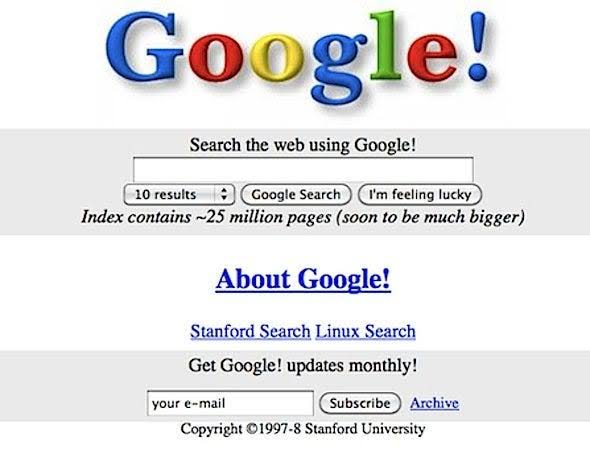
This changed how keywords worked inside search. Two websites could target the same keyword, use similar titles, and discuss the same topic, yet the page receiving more quality links could rank higher. Keywords still mattered, but they now needed support from authority signals. For the first time, ranking was no longer based solely on matching words; it also depended on whether the page had earned recognition from other websites.
2003: Google Learned That Keywords Can Be Manipulated
As Google became the dominant search engine, website owners and early SEO practitioners began recognizing patterns in its rankings and discovered that keywords could be manipulated through repetition, hidden text, and excessive optimization. Pages could rank simply by repeating phrases like “cheap hotel” dozens of times, even when the content offered little value. Google increasingly realized that keyword signals alone were unreliable, marking the point when more keywords no longer automatically meant better rankings.
At the same time, Google faced another problem: it still relied heavily on literal keyword matching. A search for “feline illnesses” might overlook an excellent veterinary article simply because the page used the word “cat” instead of “feline.” The web itself was also becoming increasingly noisy, filled with duplicated, low-quality, and heavily optimized content. Google needed a better way to understand relationships between words and the real meaning behind a search query.
Google Search in 2004: Turning Point, How SEO Keywords Work, from Keywords to Contexts + Data At Scale
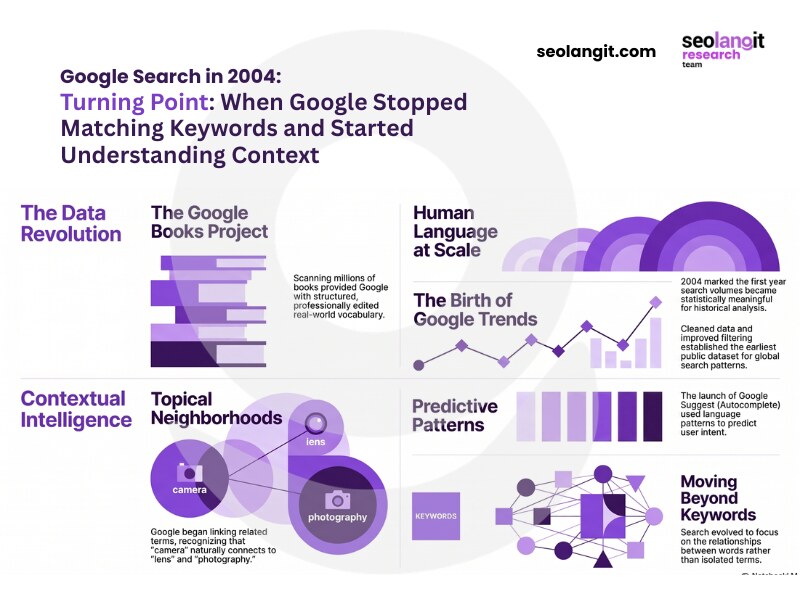
The turning point of search engine mechanism that change how the SEO Google keyword works & behaved in the early phase
After recognizing the limitations of exact keyword matching, Google needed a better way to understand how words relate to one another. To see its turning point, we have to go back in late 2004 first, the company launched the Google Books project, scanning millions of books from major libraries and universities. Unlike the web, books provided professionally edited, highly structured language, giving Google access to a massive collection of real-world vocabulary, topics, and relationships.
As Google analyzed this information alongside the web, it became increasingly capable of recognizing that certain words frequently appeared together. Pages discussing “camera” often mentioned “lens,” “photography,” “shutter speed,” or brands such as “Nikon” and “Canon.”
Instead of treating every keyword as an isolated term, Google began understanding topical neighborhoods and contextual relationships. Search was slowly moving beyond exact words and toward understanding concepts and meaning.
Google Started Collecting Human Language at Scale
Although Google had recorded search queries since its early years, 2004 became an important milestone because the company finally possessed enough clean and reliable data to observe how people use language at scale. By this period, internet adoption had grown significantly, search volumes became statistically meaningful, and improved filtering systems helped separate genuine human searches from automated or spam activity. This period later became the historical starting point for Google Trends, which still uses 2004 as its earliest public dataset.
At the same time, Google introduced Google Suggest (Autocomplete), allowing the search engine to predict queries as users typed. Combined with millions of books and billions of searches, Google could observe which words frequently appeared together, which topics were connected, and how people naturally expressed ideas. Keywords were gradually becoming part of larger language patterns, helping Google move from matching individual words toward understanding topics and relationships.
2005: Keywords Became “Personal”
In 2005, Google keywords worked and introduced personalized search, allowing search history and user behavior to influence results. The same keyword could now produce different outcomes for different people: someone searching for “pizza” might see nearby restaurants, while another user could receive recipes or cooking guides. For the first time, Google was not only trying to understand the keyword itself, but also the person behind the search, recognizing that identical words can represent different intentions.
2005 Launch of Google Local Business Center: Local Search Connected Keywords to Physical Places
The same year, Google launched the Local Business Center, allowing business owners to directly submit their addresses, phone numbers, operating hours, and locations to Google. This marked the beginning of what would eventually evolve into Google Business Profile and modern local SEO.
For the first time, Google could combine a keyword with a physical location. A search for “pizza,” “dentist,” or “hotel” no longer required Google to understand only the words being typed or the person performing the search. It also needed to understand where the search was happening. Keywords gradually became connected to places, giving nearby businesses the opportunity to appear even without strong websites or traditional SEO signals. The Local Business Center introduced in 2005 became one of the foundations of modern local SEO, where location, proximity, and business information became just as important as the keyword itself.
2010: Search Started Moving in Real Time
By the end of the 2000s, Google had become increasingly capable of understanding keywords, related topics, and even user behavior. However, the internet itself was changing. Blogs, news websites, forums, and social media were producing new content every minute, while Google’s older indexing systems often required days or even weeks to fully process and update search results.
In 2010, Google moved toward continuous indexing, allowing new pages to be discovered and added to search results much faster. Breaking news, trending topics, and current events could now appear in search results almost immediately after publication. Keywords were no longer only connected to relevance and meaning; they also became connected to time. Fresh content suddenly had the ability to compete alongside older, established pages.
2011: Content Quality Became Part of the Keyword Equation
Keywords remained important, but usefulness and depth had become essential ranking signals
By 2011, Google had become increasingly capable of understanding words, topics, users, and freshness, but another problem had emerged: the web was being flooded with thin articles, mass-produced content, and pages created primarily to target keywords. Large content farms could publish thousands of low-value pages that ranked simply because they covered popular search terms.
This period also marked the beginning of Google’s more visible algorithm era. One of the most widely discussed updates was Panda, which became one of the first algorithm names recognized by the broader SEO industry. For many website owners, this was the moment they realized that Google’s ranking systems were actively evolving and that content quality had become a major ranking factor.
For the first time, content quality became part of the keyword equation. A page could contain the correct keywords, relevant topics, and even fresh information, yet still struggle to rank if it offered little value to readers. Keywords remained important, but usefulness, depth, and overall content quality had become essential ranking signals.
2012: It Happened, Google Got Serious, Trusting “Things” Instead of Words
What happened to Google in 2012 is the year Google got serious: many websites were buying backlinks or creating thousands of identical anchor texts to manipulate rankings. After improving content quality on previous years, Google turned its attention to another major problem “artificial popularity”. The update called Penguin punished them, targeted spammy link-building practices and anchor keyword-heavy backlinks, becoming one of SEO’s most famous algorithm names. External keyword signals could no longer be trusted simply because they existed, forcing Google to evaluate whether a page had earned its authority naturally.
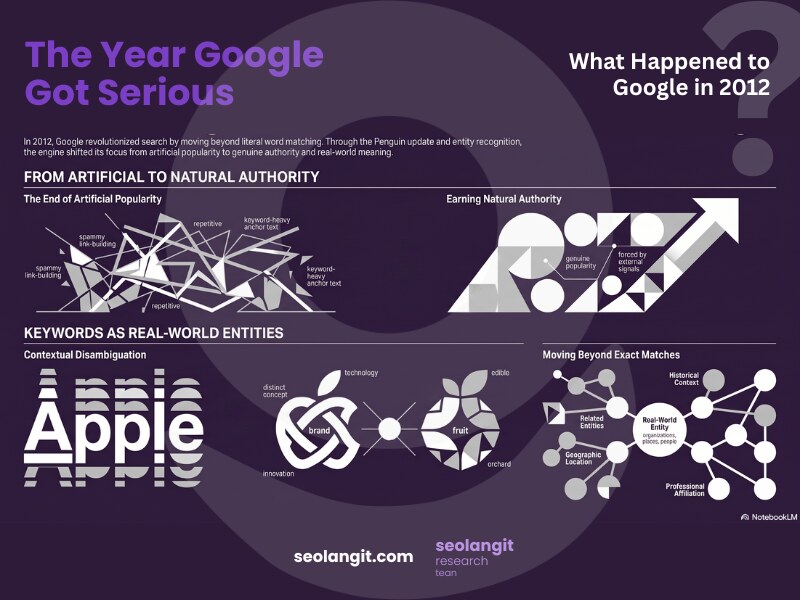
In 2012, Google’s Penguin update penalized artificial links, while entity recognition helped Google understand keywords as real-world things, not just words
At the same time, Google began understanding keywords as real-world entities rather than isolated words. A search for “Apple” could refer to the technology company, the fruit, or another meaning entirely depending on the context. People, places, brands, and organizations increasingly became part of Google’s understanding of search, allowing the engine to connect information beyond exact keyword matches.
Together, these changes represented an important shift in how Google handled keywords. The search engine was becoming less interested in whether a keyword appeared in links or on a page and more interested in what that keyword actually represented. Popularity needed to be genuine, and words needed to have meaning. Keywords were gradually evolving from ranking signals into “Genuinely Representations of Real-World” concepts.
2013: Search Shifted From Words to Meaning
By 2013, Google had already learned that keywords could be manipulated, that related words belong to the same topics, and that people often use different terms to describe the same thing. The next challenge was understanding complete searches rather than individual words, allowing Google to interpret a query as a whole instead of simply matching isolated keywords.
A search such as “Where can I buy a camera for wildlife photography?” no longer depended solely on finding pages containing the words “camera” or “photography.” Google increasingly understood the relationship between the terms, recognized the user’s intent, and attempted to deliver the type of answer the searcher actually wanted. Search was gradually shifting from matching words to understanding meaning.
2015: Machines Began Learning Search Patterns
By 2015, How Google keywords work had become capable of using machine learning to recognize patterns between searches, topics, and user behavior. This allowed the search engine to better understand queries it had never encountered before, even when the exact words had little historical data or did not perfectly match existing content. Instead of relying solely on predefined rules or exact keywords, Google increasingly learned from relationships and patterns, enabling it to infer meaning even from unfamiliar searches.
2018 Google Search Engine: Expertise, Authoritativeness and Trustworthiness
By 2018, Google had become increasingly capable of understanding keywords, topics, entities, and search intent. However, another challenge had emerged: the internet was producing more information than ever before, making it increasingly difficult to determine which sources could actually be trusted. Two articles might answer the same question, yet one could come from an experienced professional while the other offered inaccurate or misleading information.
As a result, Google began placing greater emphasis on credibility in terms of Expertise, Authoritativeness and Trustworthiness (E-A-T). Questions such as “Who created this content?” and “Why should users believe this information?” became increasingly important. Keywords alone could no longer establish authority. This shift would later become one of the foundations of the modern internet, where podcasts, creators, industry experts, and trusted voices compete alongside traditional websites in an increasingly crowded information landscape.
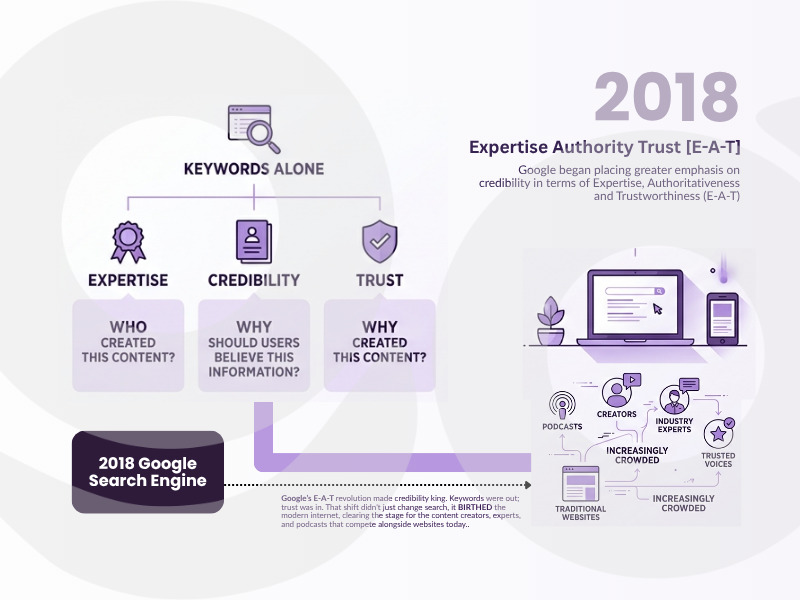
Google’s 2018 E-A-T revolution made credibility more important. That shift birthed the modern internet: for creators, experts, and podcasts
2019: Google Learned How “Humans” Read Language
After placing greater emphasis on expertise and trust, Google continued improving its understanding of language itself. Context, sentence structure, and even small words began playing a larger role in determining meaning, allowing Google to interpret searches more similarly to how humans read and understand text. As a result, natural writing became increasingly effective, while repetitive keyword usage became less important because Google could now understand meaning from the entire sentence rather than individual words alone.
2021: Search Expanded Beyond Text
Keywords remained important, but they became only one signal among many
By 2021, the internet had become increasingly visual, multilingual, and interconnected. The rapid growth of mobile devices, video platforms, online learning, and digital activity during the pandemic years accelerated how people consumed information, often relying on images, voice, and visual content alongside traditional text searches. Search behavior itself was becoming more diverse than simple keyword queries.
As a result, Google increasingly expanded its understanding beyond text alone, connecting information across images, languages, and different types of content. Keywords remained important, but they became only one signal among many. Search was evolving from understanding words and sentences toward understanding information regardless of how it was expressed or where it appeared.
2022: Helpfulness Became More Important Than Optimization
By 2022, Google had already spent years improving its ability to understand keywords, topics, intent, entities, and even content quality. But a new priority became more explicit: content needed to be genuinely useful for people, not just optimized for search engines. This marked a shift in how pages were evaluated, where usefulness, clarity, and real value began to outweigh technical optimization alone.
This change reinforced a deeper question behind every piece of content: would this article still exist if search engines did not? Pages that existed only to target keywords or satisfy ranking systems increasingly struggled, while content created to genuinely help users gained stronger visibility. Keywords were still part of the system, but the value of the content itself had become the most important signal.
2024: Keywords Started Triggering Answers Instead of Rankings
By 2024, artificial intelligence had become directly visible inside Google Search through AI Overviews, the global rollout of a feature previously introduced as the Search Generative Experience (SGE). Instead of simply presenting a list of webpages, Google increasingly generated summarized answers by combining information from multiple sources. The traditional search experience of
“keyword > ranked pages”
was gradually evolving into:
“keyword > generated answer”
This transformation did not happen overnight. The ability to understand related words, entities, search intent, natural language, expertise, and helpfulness had been developing for years, ultimately providing the foundation for AI-generated search experiences. Rather than replacing the web, AI Overviews became an intelligent layer on top of it, citing webpages through links, source cards, and expandable references. For SEO, this introduced a new objective: becoming a trusted source that Google’s AI chooses to reference, not just a page that ranks highly in the traditional search results.
The impact extended far beyond search technology. As AI Overviews increasingly answered questions directly on the results page, users often found the information they needed without clicking through to a website. Based on our research and experience, this accelerated the growth of zero-click searches and changed how publishers, marketers, and SEO professionals measure success.
Ranking first in the traditional organic results remained valuable, but visibility inside AI-generated answers was becoming an entirely new form of search optimization. Keywords were no longer simply retrieving documents, thus they were increasingly helping Google understand questions, synthesize knowledge, and generate answers.
Rethinking How Google Keywords Work Today Through Historical Changes
Looking back from 1998, one thing becomes increasingly clear: the evolution of keywords was never simply about improving search rankings. It was Google’s continuous effort to better understand information, eliminate manipulation, and ultimately connect people with the answers they were actually looking for. Every major milestone represented another step away from matching words and another step toward understanding meaning.
This history timeline also reveals two consistent patterns. First, Google has steadily placed greater importance on the credibility behind information, rewarding expertise and trustworthy sources rather than pages that simply contain the right keywords. Second, keywords themselves have gradually evolved from exact matching signals into contextual clues. As Google’s understanding of language, topics, and relationships matured, a keyword became less about repeating specific words and more about helping Google understand the broader subject being discussed.
Perhaps the most important lesson is that every keyword begins with “a person’s emotion”. Behind every search is a question, a pain, a problem, a curiosity, or a decision someone is trying to make. The most effective keyword strategies therefore start by understanding the people behind the searches rather than the searches themselves. When we focus on solving real problems with accurate, trustworthy, and genuinely helpful content, we naturally align with the direction Google has been moving toward for more than two decades.
That perspective has shaped how we approach SEO.. – SEOLANGIT
Rather than treating keywords as isolated ranking targets, we view them as entry points into larger topics, search intent, and user needs.
After years of observing Google’s evolution and working across different stages of search, one principle has remained remarkably consistent: search technology will continue to change, but creating content that helps people, demonstrates expertise, and earns trust has proven to be one of the most durable SEO strategies. While no one can predict exactly where search will go next, understanding why Google has evolved gives us a stronger foundation for adapting to whatever comes next.
Source:
- Google Algorithm Updates: A Timeline
- A brief history of Google’s algorithm updates
- Timeline of Google Search
- Google Algorithm Updates & Changes: A Complete History
- How AI powers great search results
- The Anatomy of a Large-Scale Hypertextual Web Search Engine (original PageRank paper)
- Stanford PageRank paper PDF
© 2026 SEOLANGIT. All rights reserved

Leave a Reply