

AI Optimization
AI Optimization improves how AI recognizes, understands, and recommends your brand or business by strengthening the quality, consistency, and authority of the information available about it across digital platforms and online sources.
As AI becomes an increasingly important way people discover information, compare businesses, and make decisions, the quality of your online presence plays a growing role in how your business is represented in AI-generated responses.
Understanding how AI evaluates businesses provides a stronger foundation for improving how your business is recognized, interpreted, and recommended across the AI ecosystem.
AI Assessment
Using our own research-driven and LANG methodology, we optimize your web presence across four stages of AI understanding: Recognition, Accuracy, Understanding, and Recommendation.
AI Search
Behaviour
For more than two decades, search engines have been the primary way people discover businesses and information online. Today, AI is becoming another important way people search, explore, and make decisions. Instead of simply looking through a list of links, many people now ask questions and expect direct, contextual answers.
As AI changes how people discover businesses, success increasingly depends on being recognized, understood, and represented accurately. This is where AI Optimization becomes increasingly important.
To understand why AI Optimization matters, it’s important to first understand how search behavior is changing.
From Keywords to Questions
People are increasingly asking complete questions instead of typing a few keywords into a search engine.
From Multiple Websites to Direct Answers
Instead of visiting multiple websites to compare information, users increasingly expect AI to provide a clear, summarized response.
From Information to Finding Recommendations
Instead of simply finding information, people increasingly rely on AI to compare products, evaluate services, and recommend businesses based on their needs.
From Content to Discovering Expertise
People aren’t only looking for content anymore. They also want to identify the people, businesses, and organizations with the expertise to solve their problems.
Understanding
AI Optimization
What Is AI Optimization?
AI Optimization is the practice of improving the quality, consistency, and authority of digital information across online sources so artificial intelligence can more effectively acquire, organize, evaluate, synthesize, and use that information to generate relevant responses and recommendations
As AI search evolves, several terms have emerged to describe the practice of improving visibility in AI-generated responses, including Answer Engine Optimization (AEO), Generative Engine Optimization (GEO), AI Search Optimization, Large Language Model Optimization (LLMO), AI SEO, etc.
While each focuses on a different aspect of the discipline, they ultimately pursue the same objective. For consistency, SEOLANGIT will use the term “AI Optimization“, reflecting the broader definition of helping AI recognize, understand, and confidently recommend brands across the AI ecosystem.
AI Optimization does not improve artificial intelligence itself. Instead, it improves the quality of the digital information AI relies on. As that information becomes more accurate, consistent, and authoritative, AI is better equipped to understand and represent your business in relevant interactions.
AI Optimization
Frameworks
SEOLANGIT AI Optimization Framework
When people ask AI about a product or business, the answer they get depends on how well the AI knows the information it has. This understanding doesn’t happen all at once. It grows progressively as the AI comes across more accurate, consistent, and trustworthy information from across the internet.
Our AI Optimization framework is built around 4 (four) layers that reflect this progression:
Recognition > Accuracy > Understanding > Recommendation
Each layer builds on the one before it. Before AI can confidently recommend an entity, it must first recognize that it exists, represent its information accurately, and develop an understanding of what it does and why it is relevant
01 Recognition
Recognition is the foundation of AI understanding. Before AI can answer questions, it first needs to recognize your product, brand or company as a distinct and identifiable entity
Questions AI Should Be Able to Answer:
Who is this company?
What is this brand?
Tell me about this business.
Does this organization exist?
Objective:
Help AI confidently recognize your business as a unique and identifiable entity.
02 Accuracy
The Correct Answer
About Your Brand
Once AI recognizes your business, the next step is understanding the facts correctly. Accurate and Consistent information helps AI generate more reliable responses and reduces confusion caused by conflicting sources.
Strengthen the consistency and reliability of the information AI uses to represent your business.
Whenever users ask an AI about your brand: where your company is located, how to contact your sales team, your official website, or your social profile, the answer will be factually correct and mostly predictable
03 Understanding
Once AI can recognize your business and represent it accurately, the next step is developing a deeper understanding of your expertise, positioning, audience, and the problems you solve.
AI develops a stronger understanding by combining the following elements into a more complete representation of your business:
Semantic Clarity
AI clearly understands what your business does and why it exists
Topical Depth
AI recognizes your expertise within your area of specialization.
Contextual Links
AI understands how your business or brand relates to others
“Build a stronger understanding of your expertise and topical authority..”
04 Recommendation
The highest layer of AI Optimization is becoming a relevant recommendation. When people ask AI for products, services, expertise, or trusted sources, the goal is to strengthen your business’s ability to be recognized as a relevant option within AI-generated responses.
As AI develops a more complete and reliable representation of your business, it becomes better equipped to cite, mention, and recommend your brand when it genuinely matches the user’s intent.
AI Optimization
Methodology
The four layers explain how AI progresses from recognizing a business to confidently recommending it. The next question is how that progression can be strengthened.
AI Optimization focuses on improving the quality, consistency, and authority of the information available about your business across online sources. As that information becomes more complete and reliable, AI can build a more accurate representation of your business over time.
Rather than relying on platform-specific tactics or short-term techniques, the methodology is built around a set of fundamental principles that contribute to stronger AI representation.
Identity Alignment
Present your business consistently across online sources. Consistent names, branding, and business information make it easier for AI to recognize your business as a single, identifiable entity.
Clear Information
Maintain accurate, complete, and up-to-date information wherever your business appears online. Reliable information helps AI provide more dependable and consistent responses.
Helpful Content
Create content that genuinely helps your audience. Useful content gives AI richer context about your products, services, expertise, and the problems your product or service solves.
Topical Authority
Develop expertise around the subjects most relevant to your business. Consistently publishing high-quality content strengthens the association between your business and the topics you want to be known for.
Digital Presence
Build a presence across trusted websites, platforms, and publications. Information supported by multiple credible sources provides a stronger foundation for AI to interpret and represent your business.
Ongoing Consistency
Keep your business information and content accurate as your business evolves. AI continues to learn from new information, making consistency an ongoing process rather than a one-time effort.
AI Ecosystem
and Environment
AI Optimization Across the AI Ecosystem
An AI ecosystem is the network of digital environments that collectively shape how AI understands people, organizations, products, and places.
The methodology focuses on improving information, but where does that information actually come from and where to apply? AI develops its understanding by interpreting information published across many online sources. Your website remains an important foundation, but it is only one part of the broader information ecosystem AI uses to understand your entity.
In other words: the strength of an AI ecosystem is determined not just by the number of platforms where an entity appears, but by how consistently those sources reinforce the same understanding of the business.
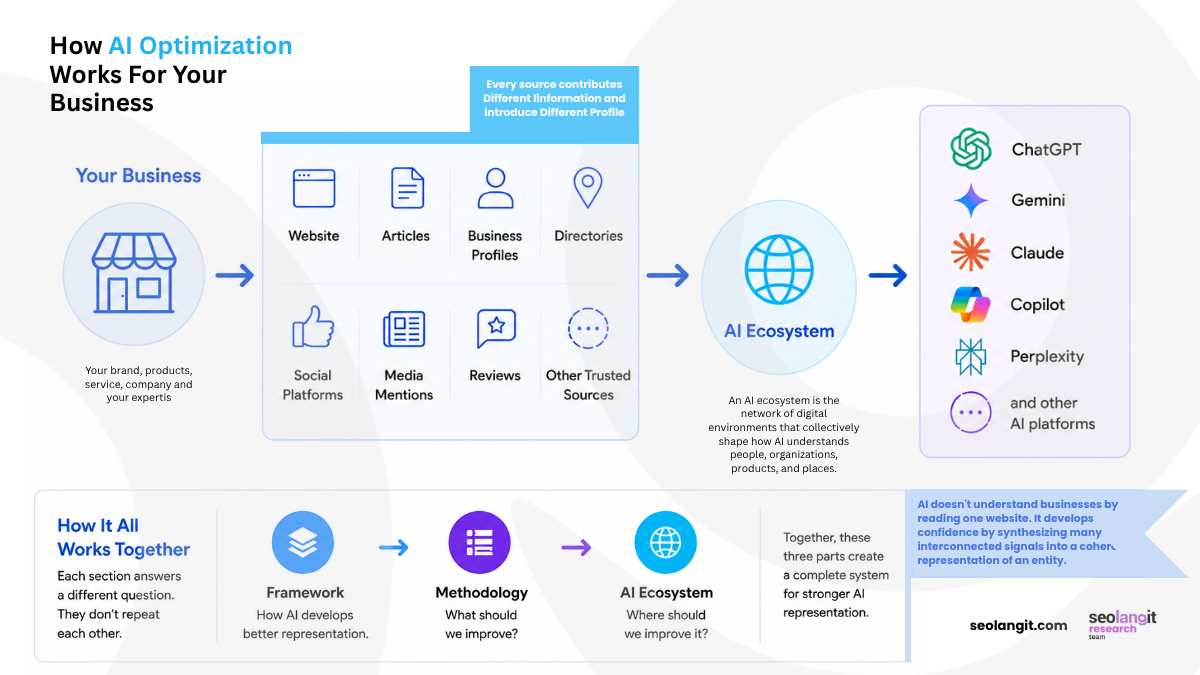
How AI Builds an Understanding of Your Business
Every online source contributes a different piece of information or different profile about your business. Together, they synthesize and form a broader picture that AI can interpret when answering questions, comparing businesses, or providing recommendations.
For this reason, AI Optimization is not designed for a single AI platform (GPT, Deepseek, Gemini, etc). The same principles apply across the wider AI ecosystem because they focus on improving the information that many AI platforms rely on.
AI Optimization strengthens the information environment that shapes how businesses are represented across AI-generated responses
How To Measure
AI Optimization
Measuring AI Optimization Progress
Unlike traditional SEO, where progress is often measured through rankings and organic traffic, AI Optimization focuses on evaluating how accurately and consistently AI represents your business. Rather than relying on a single metric, progress can be observed by examining how AI recognizes your business, represents important information, understands your expertise, and recommends your business in relevant situations
The four layers introduced earlier provide the framework SEOLANGIT uses to evaluate AI Optimization progress. Together, they offer a structured way to understand how AI recognizes, interprets, and recommends your business over time.
Framework
Questions to Consider
Recognition
Can AI identify your business as a distinct entity?
Accuracy
Are important facts about your business represented correctly?
Understanding
Does AI accurately describe your expertise, products, or services?
Recommendation
Is your business cited, mentioned, or recommended when relevant?
As the quality, consistency, and authority of information about your business improve, each layer can become stronger over time. Measuring progress across all four layers provides a clearer picture of how AI Optimization efforts are contributing to better AI-generated responses and recommendations
Before You Start
AI Optimization
How AI Optimization Connects Your Digital Marketing Efforts and Where To Begin
Before begin, here’s the key context to keep in mind: AI Optimization IS NOT a standalone activity. It brings together multiple areas of digital marketing that influence how AI learns about your business.
“Each discipline contributes a different piece of information. AI Optimization provides a unified framework that connects these activities..”
SEO helps important content become more discoverable. Content creation explains your expertise and provides context about your products and services. Social media strengthens your brand presence, while digital PR and online mentions reinforce credibility across the internet.
Before improving any of these areas, it’s important to understand your current starting point. A structured review helps identify strengths, gaps, and opportunities across your online presence, making it easier to prioritize the areas that will have the greatest impact on your AI Optimization efforts.
Evaluate the Quality, Consistency, and Credibility of Your Online Presence Before Starting AI Optimization
Every AI Optimization project should begin with an assessment. Before deciding what to improve, review your existing online presence to understand how well your business is represented today. Focus on the following areas:
#1 Core Identity
Start by evaluating whether your business presents a single, recognizable identity across its online presence. Your business name, branding, contact details, and other core information should clearly represent the same organization wherever they appear.
#2 Business Information
Evaluate the accuracy, completeness, and freshness of your business information. Company descriptions, products or services, locations, contact details, and other essential information should remain clear, consistent, and up to date across all official sources.
#3 Content Expertise
Assess whether your content clearly explains what your business does, who it serves, the expertise it offers, and the topics you want to be known for. Your content should accurately reflect the knowledge and experience behind your business.
#4 Online Credibility
Evaluate how your business is represented beyond its own website. Business profiles, directories, publications, reviews, mentions, citations, and other trusted online sources should collectively strengthen your credibility and provide broader context.
#5 Semantic Relationships
Content should cover the subjects most relevant to your business with sufficient depth and clear relationships between related topics. A well-connected body of content helps reinforce expertise and provides stronger context for AI to interpret your business.
#6 References & Link
References from relevant and trustworthy websites strengthen the broader context surrounding your business. Backlinks, citations, editorial mentions, partnerships, and other third-party references should contribute to a credible and well-supported online presence.
#7 Reputation & Trust
Review how your business is represented through independent sources and customer feedback. Reviews, testimonials, case studies, awards and other signals of trust should accurately reflect your reputation and strengthen the credibility associated with your business.
#8 Ongoing Maintenance
Your online presence should evolve alongside your business. As products, services, teams, or positioning change, business information and content should remain current so that both people and AI continue to encounter accurate and relevant information.
FAQ Most
Common Questions
We’ve gathered the most common questions about AI optimization from ours community forums and business owners; so you can skip the guesswork and launch with confidence.
What is AI Optimization?
AI Optimization is the practice of improving the quality, consistency, and authority of information about your business across online sources so artificial intelligence can more effectively recognize, understand, and recommend it. Rather than optimizing AI itself, AI Optimization strengthens the information AI relies on to generate more accurate and relevant responses.
Is AI Optimization the Same as AI Search Optimization?
As AI search continues to evolve, several terms have emerged to describe this discipline, including AI Search Optimization, Answer Engine Optimization (AEO), Generative Engine Optimization (GEO), Large Language Model Optimization (LLMO), AI SEO, and other variations.
While each emphasizes a slightly different aspect of the field, they generally share the same objective: improving how businesses are represented in AI-generated responses.
Throughout this website, SEOLANGIT uses the term AI Optimization because it reflects a broader perspective that extends beyond AI search alone. It encompasses improving how AI recognizes, understands, and recommends businesses across the wider AI ecosystem.
Explore more on AI Optimization Service Plans
Does AI Optimization Replace SEO?
No. AI Optimization is not a replacement for SEO. Instead, it complements SEO as part of a broader digital strategy.
SEO focuses on helping search engines discover, understand, and rank your content so people can find it through search results. AI Optimization focuses on improving the quality of the information AI uses to interpret and represent your business in AI-generated responses.
Together with content creation, business profiles, social media, digital PR, and other online activities, SEO and AI Optimization work together to strengthen your overall online presence.
Which AI Platforms Does AI Optimization Apply To?
AI Optimization is designed for AI platforms and applications that interpret information from the internet to answer questions, explain topics, compare products, and recommend businesses. These include ChatGPT, Gemini, Claude, Microsoft Copilot, Perplexity, AI-powered search experiences, and similar technologies that rely on information published across the web.
Although each platform uses different models, technologies, and methods for retrieving information, they all depend (directly or indirectly) on information available across the internet. By improving the quality, consistency, and authority of that information, AI Optimization helps strengthen how businesses are represented across today’s AI platforms and those that continue to emerge.
Do I Need to Optimize Separately for Every AI Platform?
No. AI Optimization focuses on strengthening the information about your business rather than optimizing individual AI platforms.
Instead of creating a different strategy for ChatGPT, Gemini, Claude, Copilot, Perplexity, or future AI platforms, the methodology improves the underlying information they rely on. This platform-independent approach helps support more accurate and consistent AI-generated responses across the broader AI ecosystem.
How Long Does AI Optimization Take?
AI Optimization is an ongoing process rather than a one-time project. The time required to see meaningful improvements depends on several factors, including the current quality of your online presence, the consistency of your business information, the depth of your content, and how frequently AI platforms update or incorporate new information.
Because every business starts from a different point, progress is best evaluated through continuous improvement rather than a fixed timeline.
How Do I Know if AI Optimization Is Working?
The most effective way to evaluate AI Optimization is by measuring progress across the four stages of the SEOLANGIT AI Optimization Framework:
- Recognition: Can AI identify your business as a distinct entity?
Accuracy: Are important facts about your business represented correctly?
Understanding: Does AI clearly explain your expertise, products, or services?
Recommendation: Is your business cited, mentioned, or recommended when it is relevant?
Together, these four stages provide a practical framework for assessing how AI’s understanding of your business develops over time.
- Recognition: Can AI identify your business as a distinct entity?
Can AI Optimization Improve AI Recommendations?
Yes. AI Optimization strengthens the quality, consistency, and authority of the information AI relies on, helping AI build a more complete understanding of your business. As that understanding improves, your business is better positioned to be cited, mentioned, or recommended when it is relevant to a user’s needs.
Recommendations ultimately depend on the context of each user’s question and the way individual AI platforms evaluate relevance.
How Can I Evaluate My Current AI Optimization?
The best place to start is with an AI Optimization Audit. Before making improvements, it’s important to understand how your business is currently represented across its online presence.
A comprehensive review should evaluate key areas such as your business identity, business information, content and expertise, online credibility, semantic relationships, references and links, reputation, and ongoing maintenance. Together, these areas provide a strong foundation for understanding where improvements are most needed.
Can I Improve AI Optimization Myself?
Yes. Many aspects of AI Optimization can be improved by maintaining accurate business information, publishing helpful content, strengthening your expertise, and building a credible online presence.
The challenge is knowing which improvements will have the greatest impact and how they work together. A structured methodology helps prioritize opportunities, identify gaps, and create a more effective long-term strategy.
Why Choose SEOLANGIT for AI Optimization?
AI Optimization builds on many of the same principles that have shaped effective SEO, content strategy, and digital visibility for years. With more than a decade of experience helping businesses improve their online presence, SEOLANGIT combines that foundation with ongoing research into how modern AI platforms discover, interpret, and represent information.
Rather than focusing on short-term tactics or a single AI platform, our approach is built around a research-driven methodology that helps businesses strengthen the quality, consistency, and authority of their online information across the broader AI ecosystem.
Getting
Started
Start Your AI Optimization Journey
Every business starts from a different point. An AI Optimization Assessment helps identify your current strengths, uncover opportunities for improvement, and establish a practical roadmap for building a stronger presence across today’s AI ecosystem.